
Selling & Marketing
Selling a house in Hilscheid: process, price, timeframe
It usually begins not with a decision, but with a sentence at the kitchen table: “We really ought to sell the house at some point.” Then the idea lingers for months because no one knows where to start. This article describes the journey from that sentence to the day you hand over the keys.
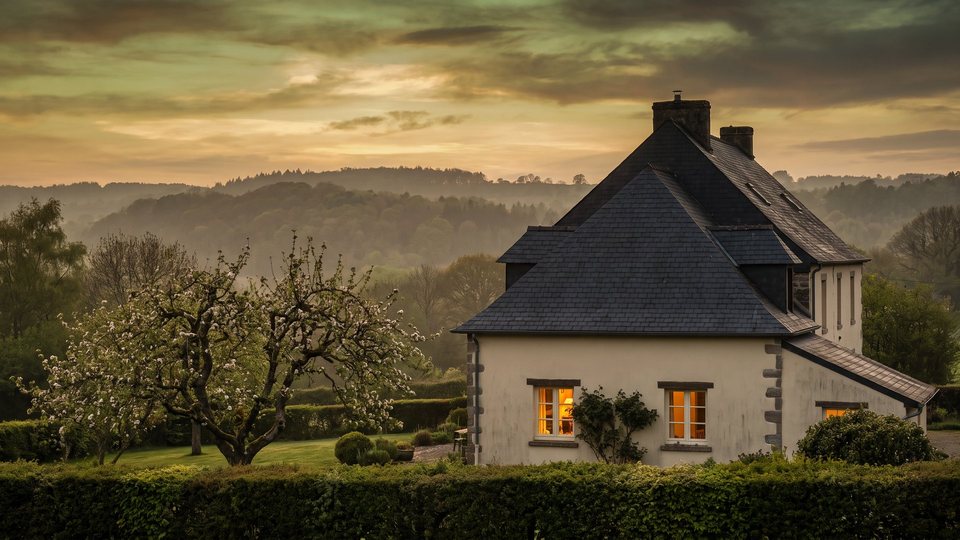
An impression of the landscape around Hilscheid, generated with artificial intelligence. It shows neither a specific place nor a specific building and is not a photograph of one of our properties.
Article L-0221 · 25.11.2026 · 6 min. reading time · Joé Christian Ewrard
The process in eight steps — and what actually takes time
In practice, selling a house in Hilscheid works like this: First, gather the documents. Second, assess the condition honestly. Third, determine the price. Fourth, prepare the marketing materials, namely photos, floor plan, property brochure and energy performance certificate. Fifth, publish the listing. Sixth, conduct viewings and discussions. Seventh, reservation, confirmation of the buyer’s financing and the notary appointment. Eighth, payment of the purchase price and handover of the keys.
Steps one to four are the ones you control yourself — and these are precisely the ones most often underestimated. Anyone who states a plot size from memory and later finds a different figure in the land register extract loses the buyer’s trust, and nothing can restore it.
Steps seven and eight are beyond your control. There is always a waiting period between signing at the notary’s office and handing over the keys: The land registry must enter the priority notice of conveyance, the notary must send the payment due notice, and the buyer’s bank must release the funds. How long this takes depends on the authority and the bank, not on you or your estate agent. Anyone who promises you a date at this stage is promising something they cannot guarantee.
Therefore, do not plan around a fixed date, but around a sequence of events. If you want to buy or rent another property at the same time, discuss this with us early on — interim financing and bridging arrangements can be organised, but not in the week before the move.
Which documents you need before anyone even visits
For a house in the Bernkastel-Wittlich district, these usually include: a land register extract, site plan and cadastral map, calculation of living and usable floor space, building plans and planning permission, energy performance certificate, documentation of renovations, property tax assessment notice, tank details for heating oil or liquefied gas, and a certificate of inheritance in the case of communities of heirs.
In places like Hilscheid, many of these documents are not kept together in one folder, but are spread across several sources: some are held by the property owner, some by the Verbandsgemeinde, some by the cadastral office, and some by tradespeople who replaced the heating system twenty years ago. Expect gathering everything to take weeks, not days — and start before the house is listed online. A buyer waiting for documents will meanwhile be talking to their bank about another house.
The following applies to the energy performance certificate: It must be available at the viewing and is requested in the listing. Without it, a mandatory field remains incomplete on every property portal.
What affects the price in Hilscheid — and why there is no price per square metre here
So far, we have handled one property in Hilscheid, a house. A single figure cannot be used to derive a price per square metre for the location, which is why we do not quote one. Any figure someone gives you as the “market price per square metre” for a place of this size is based on an average for an entire region — and says little about your house.
What actually affects the price per square metre in a place like Hilscheid can be clearly identified. First, the condition of the building services: heating, electrical systems, windows, roof. A house with a new heating system and an insulated roof is in a different negotiating position from the same house with a system dating from the nineties. Second, the layout: Many houses here have numerous rooms across several levels, having evolved over generations. For families, that is an advantage; for a retired couple, it is space that needs to be heated. Third, the plot and what it allows. Fourth, accessibility — Hilscheid is situated differently in terms of convenience for commuters travelling towards Trier and the Hunsrück, and buyers calculate this in driving minutes, not kilometres. Fifth, comparability: In a small village, two similar houses are rarely for sale at the same time. That can help — and it makes pricing more challenging because the nearest genuine comparison is often in a neighbouring village.
Our current listing in Hilscheid is a house with 144 square metres and 8 rooms priced at 229.000 euros. That is an asking price, not a sale price — and it is one data point, not a statement about the market.
Too high or too low: the fear that holds back almost every seller
The most common concern we hear around the kitchen table is not “Will we find a buyer?”, but “Are we selling it for less than it is worth?”. This is closely followed by the second concern: “And what if we start too high and no one calls?”
Both concerns are justified, and they carry different costs. A price that is too low costs you money you will never receive. A price that is too high costs you time — and, more importantly, attention. Prospective buyers view a house that has been listed online for a long time differently: What is wrong with it? Subsequent price reductions are visible on the portals and are interpreted as a sign of weakness. That is why the initial asking price is the one decision in the entire process that is difficult to correct.
Our approach: We set the price at a level that generates enquiries and then negotiate from a position in which several prospective buyers are involved in discussions. Our properties in Hilscheid have received a total of 15 enquiries. That represents activity for a place of this size, but not a crowd — and it means that every single enquiry must be handled properly. Anyone in the Eifel who takes three days to respond to an enquiry will have lost the prospective buyer to another house in the meantime.
Viewings: fewer, but the right ones
In rural areas, the mistake is rarely “too few viewings”, but rather “too many of the wrong ones”. Every viewing costs you an evening, tidying up and frayed nerves — and if the prospective buyer ultimately says that they still need to speak to their bank, they were usually not serious from the outset.
We therefore establish in advance what a prospective buyer can afford and why they specifically want to move to Hilscheid. Buyers coming from Trier or Luxembourg have different expectations regarding travel times and infrastructure from someone from the Verbandsgemeinde. Knowing this in advance saves both sides the evening.
In practical terms, this means that your house will not be viewed constantly during this period, but only by carefully selected prospective buyers. And before every appointment, you will be told who is coming and what they want to know.
At the notary’s office: what happens there and what you need to decide beforehand
In Germany, the purchase agreement must be notarised. The notary drafts the agreement, sends it to both parties in advance, reads it out in full at the appointment and answers questions. The notary remains neutral and does not represent either party.
What you should decide beforehand: Will the bank’s land charge be discharged, and how will your own loan be repaid? Will any fixtures or items remain in the house — kitchen, awning, garden shed, heating oil in the tank — and will they be specified in the agreement? When should possession be transferred? Who will pay which ancillary costs?
We do not provide information on tax-related questions — the speculation period, owner-occupation, a sale by a community of heirs, a partial sale to relatives — and you should not accept such information from any real estate agent either. These matters should be referred to your tax adviser, while legal questions about the contract should be addressed to the notary or a lawyer. We tell you which question you need to ask there — that is our task, and that is where it ends.
When several people are involved in the decision: family, heirs, separate paths
A significant proportion of the houses sold in this area belong to several people: siblings following an inheritance, couples who are separating, parents and children. This is where sales most frequently come to a standstill — not on the market, but at the table.
What helps in practice is for everyone involved to hear the same assessment at the same time, rather than having it relayed by one person who is then seen as taking sides. That is why we meet with everyone together, including by video if someone lives far away. And we separate the two questions that are often mixed together: What is the house worth, and what should happen to the money? The first question is ours; the second is yours.
If a community of heirs cannot reach an agreement, that is a legal matter, not an issue for a real estate agent. In that case, consulting a lawyer is the more direct route.
The specific next step is a small one: Gather the documents you have in the house — land register extract, building plans, floor area calculation, evidence of renovations — and call or write to us. We will view the house, tell you openly what is missing, what affects its value and what we consider realistic. You do not have to turn this into an engagement; afterwards, you will know where you stand and can decide at your leisure.
Frequently Asked Questions
How long does it take to sell a house in Hilscheid?
We cannot provide a reliable figure for this location — we have only handled one property there to date. Realistically, preparation takes several weeks, the marketing period varies depending on the house and price, and the period between the notary appointment and handover of the keys takes several weeks because the land registry and bank set the pace.
What is my house in Hilscheid worth?
That can only be answered by assessing the house itself, not the location. We examine its condition, layout, plot and documents and compare it with sales in the surrounding area. We have only one value available for Hilscheid itself — we do not derive a price per square metre from it because it would not be meaningful.
Do I even need a real estate agent for a house in this price range?
You can also sell it yourself. The work involved remains the same: documents, energy performance certificate, pricing, listings, answering enquiries, checking creditworthiness, coordinating the notary. The question is whether you want to do this work and handle the negotiations yourself — and whether you can bear haggling with someone over your parents’ house.
What will the sale cost me?
In addition to the commission, the following costs usually apply: an energy performance certificate, land register extract and cadastral documents, any costs for discharging a land charge and, if a loan is repaid early, possibly an early repayment charge from your bank. The amount depends on your loan agreement — your bank will clarify this, not us.
Should I renovate before selling?
Major renovations are rarely worthwhile, but small things often are: tidy rooms, an unobstructed view of the spaces, repairs that every prospective buyer would otherwise mention. At the first appointment, we will tell you what makes financial sense for your house — including if nothing does.
Topics: selling a house in Hilscheid, real estate agent Hilscheid, house sale process, selling a property in the Eifel, house sale documents, property notary appointment, property valuation Hilscheid, real estate agent Bernkastel-Wittlich
Responsible for this article: Joé Christian Ewrard — agency owner & Real Estate Agent IHK, PRIOCASA Immobilien & Finanzservice. As of: 25.11.2026. The draft was created with the support of artificial intelligence and was reviewed and approved before publication (AI Transparency). This post does not replace legal or tax advice; for individual questions, please contact a notary, lawyer, or tax advisor.
The next step
Are you considering a sale?
The first step is not a contract, but a number you can rely on.
Fits well
Locations & Markets
Buying and selling real estate in Hilscheid — the market
Real estate market Hilscheid: What buyers are looking for in the Hunsrück, what sellers need to know, and who the location is not suitable for. Honest, straightforward
Selling & Marketing
Selling a house in Gries: process, price and timeframe
How does selling a house in Gries work? Find out how the price, documents, marketing and handover are prepared and what Ze
Selling & Marketing
Selling a House in Bleialf: Process, Price and Timeframe
Selling a house in Bleialf: How to plan the valuation, documents, marketing, negotiation and handover safely and without unnecessary pr
All about homeListing
What still needs to be arranged when moving out
Electricity, gas, and internet continue until someone transfers them. If you are changing the provider anyway, it’s best to compare right away.
 Listing. The comparison is conducted by Verivox, not PRIOCASA. If a contract is concluded through this, we receive a commission — the price remains the same for you. Nothing is transmitted before you click; what happens afterwards is explained in our
Privacy Policy.
The next step
One conversation is enough.
No marathon of forms, no waiting on hold. Call or write to us – you will speak directly with the people handling your request.