
Energy, Renovation & Legislation
Insulation, windows, roof: What is worthwhile before selling?
Renovate before selling or offer the house in its current condition? This question leaves many owners uncertain, as a substantial investment does not automatically result in a correspondingly higher sale price. The key is determining which measure suits the building, the energy performance certificate and the anticipated buyer group.
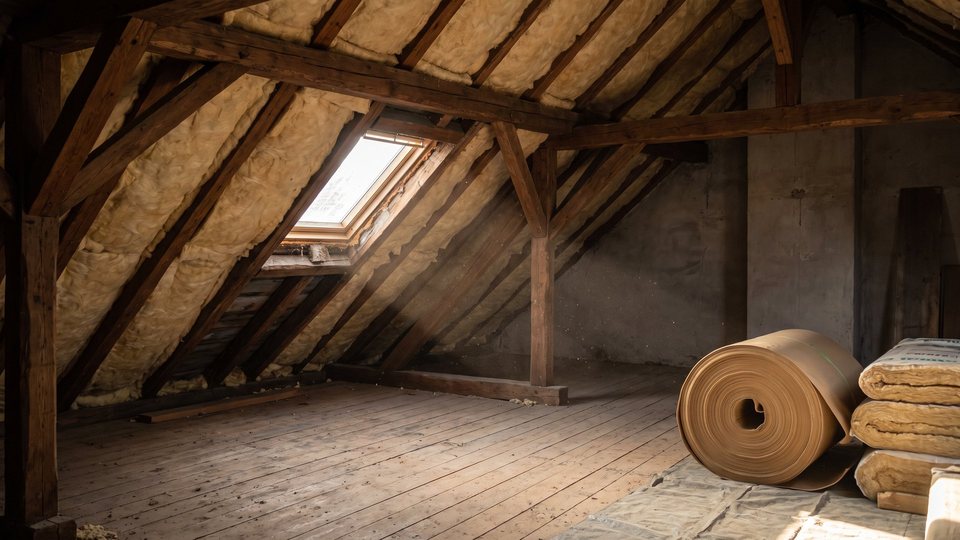
An impression relating to the subject, generated with artificial intelligence. It shows no specific building and is not a photograph of one of our properties.
Article L-0113 · 13.10.2026 · 7 min. reading time · Joé Christian Ewrard
Why renovation before selling does not always pay off
Improving a property's energy efficiency can make it more attractive. It can reduce running costs, eliminate technical risks and give buyers greater certainty when planning. However, this does not mean that every euro invested will be recouped upon sale.
Buyers do not consider energy efficiency alone. They also assess the location, plot, layout, building fabric, fixtures and fittings, and their own modernisation requirements. For example, anyone who installs high-quality roof insulation when the roof itself will need replacing in the foreseeable future is only addressing part of the problem. Prospective buyers will still factor in the remaining work.
In addition, sellers and buyers may have different preferences. New windows in a design that does not appeal to the buyer provide a technical benefit, but do not necessarily have the same impact on value. Before undertaking major work, it is therefore important to determine whether it remedies a genuine defect, visibly improves the energy performance certificate or primarily enhances personal living comfort.
In practice, it is often not the largest measure that pays off when selling, but the one that removes a specific uncertainty. A demonstrably watertight roof, professionally remedied damp or clearly documented insulation work may be more important to buyers than a comprehensive renovation without complete documentation.
How insulation, windows and the roof affect the energy performance certificate
For the energy performance certificate, the first consideration is whether it is based on calculated energy demand or actual energy consumption. A demand-based certificate assesses the building mathematically on the basis of its components and building services. Professionally installed insulation, improved windows or an energy-efficient roof renovation can therefore have a direct impact on the calculation.
A consumption-based certificate, by contrast, is based on measured energy consumption from previous billing periods. This consumption also depends on the occupants' behaviour, periods of vacancy and how individual rooms are used. A renovation completed shortly before the sale may not yet be reflected in it at all. New windows therefore do not automatically result in an immediate improvement in the consumption rating.
An existing energy performance certificate also does not update automatically once work has been completed. Whether a new certificate is required or advisable for the sale should be clarified with an authorised professional. Modernisation recommendations form part of the energy performance certificate but are no substitute for an individual renovation plan.
For marketing purposes, it is important not to present the rating in isolation. Buyers want to understand which work has already been completed, when it was carried out and whether invoices, product data, plans or contractors' declarations are available. A clearly documented level of modernisation inspires more confidence than a general statement that the house has undergone energy-efficient renovation.
When insulation before selling can be worthwhile
Insulation can be worthwhile if a clearly defined weak point can be remedied with a manageable amount of work. Typical examples include an inadequately insulated top-floor ceiling or an accessible roof area, provided that the construction, moisture protection and ventilation have been professionally assessed.
With full façade insulation, the decision is more difficult. It affects the appearance, junctions, window sills and other building components. In addition, damaged render, moisture or unclear wall constructions can influence the planning. Starting such a project solely for a sale planned in the short term can pose financial and scheduling risks.
In the Eifel, exposed locations, wind, driving rain and cold winter days play a particularly important role. Older houses in the Eifelkreis Bitburg-Prüm, the Vulkaneifel or the Trier area also have a wide variety of wall constructions. What works for a newer detached house may not be suitable for a rubble-stone house or a building that has been remodelled several times.
Before deciding on insulation, it is therefore important to consider more than just the potential energy savings. Moisture behaviour, thermal bridges, roof overhangs and junctions should also be assessed. Energy advice or a building physics assessment can prevent a new defect from being created shortly before the sale.
When new windows help and when they raise new questions
Old, draughty or visibly damaged windows can deter prospective buyers. They indicate heat loss, draughts, potential maintenance requirements and additional costs after the purchase. Replacing such windows professionally improves the first impression and can support the energy assessment.
However, window replacement should not be considered separately from the rest of the building. Highly airtight new windows change the exchange of air. If the external walls and thermal bridges remain unchanged, moisture can condense elsewhere. The installation junctions, ventilation and interaction with the building envelope must therefore be included in the planning.
From a sales perspective, there is also the question of whether complete replacement is necessary. If only individual panes are misted, fittings are defective or seals are worn, a professional repair may be the more sensible preparation. It removes a visible cause for concern without burdening the seller with a substantial investment.
Anyone having new windows installed should document the work. Buyers frequently ask about the glazing, frames, year of installation and the contractor that carried out the work. Without documentation, the quality can hardly be assessed during a viewing. Despite the new appearance, uncertainty therefore remains.
The role of the roof in the sale price and buyer confidence
The roof has a particular psychological impact when selling a house. Prospective buyers are less concerned about a single defective roof tile than about an unclear overall condition. Questions about leaks, the supporting structure, roofing and insulation quickly affect the available budget and the usability of the house.
If the roof is technically sound, it does not need to be replaced before the sale simply because of its age. An inspection by a specialist company may be more appropriate. Any minor damage identified can be repaired selectively. The inspection report and invoice make the condition easier for prospective buyers to understand.
If, however, there are signs of moisture, leaking junctions or damage to the supporting structure, the cause should be clarified before the property is marketed. Painting over a water stain does not solve the problem. If a defect is only discovered during the viewing or by the buyer's surveyor, it usually affects not only the price negotiations but also confidence in all information provided about the house.
A complete roof renovation shortly before the sale should be considered above all if there is already an urgent need for action and the work can be carried out without major scheduling or technical uncertainties. Otherwise, a transparently calculated need for renovation may be the better solution. Buyers then have the opportunity to plan the roof design, insulation standard and future use themselves.
How energy-efficiency measures affect the sale price
Better energy efficiency can increase buyers’ willingness to pay. Buyers take expected running costs, financing options and the work required after moving in into account. A house with a demonstrably well-maintained building envelope appears easier to assess than a comparable property with an unresolved backlog of renovations.
Nevertheless, the investment cannot simply be added to the asking price. The market assesses the overall package. A technical improvement can prevent a price reduction, increase the number of suitable prospective buyers or strengthen the negotiating position. However, it does not necessarily generate an equivalent increase in proceeds.
A practical example: in an older house, the roof, windows and façade are visibly showing their age. If only the windows are replaced shortly before the sale, the major questions concerning the roof and exterior walls remain unresolved. Buyers will continue to budget for a package of renovation measures. Replacing the windows alone may therefore affect their overall assessment less than expected.
The situation may be different if the building is well maintained overall and a clearly identifiable weakness is remedied. An objection then becomes a tangible advantage. The realistic impact should be assessed on the basis of the specific house, its location and comparable listings.
Does renovation shorten the time needed to sell?
Energy-efficient houses may appeal to a larger number of prospective buyers. This can make marketing easier. However, no specific time to sell can be inferred from this, as the asking price, location, layout, condition and affordability also determine demand.
Renovation work can even delay the start of the sale process. Quotes must be obtained, specialist contractors coordinated and completed work inspected and approved. If further damage comes to light in the process, the amount of work increases. Anyone already planning a specific date for the sale should take this time factor into account realistically.
The time it takes to sell can often be influenced more effectively by good preparation than by a major renovation carried out at short notice. This includes an appropriate asking price, a valid energy performance certificate, complete documentation and a clear presentation of the work already completed and the work still required.
Unclear statements, on the other hand, prolong decision-making processes. If buyers only learn after the viewing that the roof leaks or that proof of insulation is missing, they have to recalculate. Some withdraw. Transparency can therefore support the sale more effectively than superficial modernisation.
How owners can make a well-founded decision
The first step is an assessment of the current condition. This involves reviewing the roof, windows, façade, insulation, heating system, visible damage and available documentation together. A distinction should then be made between urgent defects, advisable repairs, energy-efficiency improvements and purely cosmetic work.
The likely effect of a measure on the energy performance certificate, buyers’ perceptions and the marketing process is then assessed. Quotes from specialist contractors help to estimate the work involved. A market valuation indicates whether the measure is consistent with the property’s positioning. A sound decision can only be reached by considering all these factors together.
The personal circumstances are also important. In a community of heirs, a major investment can trigger new disputes. If the house is still occupied, months of work may be unreasonable. If there are no financial reserves, a renovation must not make the sale unnecessarily risky.
Applicable building energy law requires an energy performance certificate to be made available when selling a property and provided to prospective buyers no later than at the viewing. If a certificate is already available when a commercial advertisement is published, certain details from it must be included in the advertisement. The current statutory provisions on [energy performance certificates when selling](https://www.gesetze-im-internet.de/geg/__80.html) and on [mandatory information in property advertisements](https://www.gesetze-im-internet.de/geg/__87.html) apply. Owners should consult a qualified energy adviser to determine which type of certificate, retrofitting obligation or exemption applies in each individual case, and a lawyer or notary for legal questions.
Before making an investment, first have the structural condition, the energy performance certificate and the marketing prospects assessed together. For properties in the Eifelkreis Bitburg-Prüm, Trier and Trier-Saarburg, the Vulkaneifel and along the border with Luxemburg, PRIOCASA can provide a market-based assessment; energy advisers and specialist contractors can supplement the technical inspection. This will give you a sound basis for deciding whether repairing, renovating or selling transparently in the existing condition is the appropriate next step.
Frequently Asked Questions
Should I replace the windows before selling the house?
This makes sense if the existing windows are damaged and replacement is technically appropriate for the building. If they merely look dated, a documented condition assessment may be more beneficial than replacing them all prematurely. The key factors are the costs, the building concept and the expected group of buyers.
Does new insulation automatically improve the energy performance certificate?
For a demand-based energy performance certificate, insulation that has been properly taken into account can change the calculated rating. In a consumption-based energy performance certificate, its effect only becomes apparent through actual subsequent consumption. The issuer should assess whether a new certificate is required or advisable after the work.
Does a roof renovation increase the purchase price by the full amount of its cost?
It cannot be assumed that the costs will be passed on in full. An intact and documented roof can prevent price reductions and give buyers confidence. The extent to which this affects the achievable price depends on the property as a whole and the regional market.
Can I sell an unrenovated house without any problems?
Yes, a house does not have to be fully modernised in order to be sold. However, its condition and any known defects should be described transparently. Legal questions concerning disclosure obligations should be addressed in consultation with a lawyer or notary.
Do I have to fulfil applicable renovation obligations myself after the change of ownership?
Whether obligations apply to the previous or the new owner depends on the building, its use, the previous ownership and any possible exemptions. Generalised statements are therefore risky. An energy adviser can clarify the technical aspects; binding legal advice should be obtained from a lawyer or notary.
Topics: insulation before sale, replacing windows, roof renovation, energy performance certificate, house sale Eifel, energy-efficient renovation, property sale Trier
Responsible for this article: Joé Christian Ewrard — Owner & IHK-certified real estate agent, PRIOCASA Immobilien & Finanzservice. Last updated: 13.10.2026. The draft was produced with the support of artificial intelligence and was reviewed and approved before publication (AI Transparency). This post does not replace legal or tax advice; for individual questions, please contact a notary, lawyer, or tax advisor.
The next step
How does the condition affect the price?
Energy performance and purchase price are linked — we will tell you how closely.
Fits well
Energy, Renovation & Legislation
Renovation grants: Apply first, commission work second
Making proper use of renovation funding: What options are available, who submits the application and why prematurely placing an order with a contractor can jeopardise the fund
Energy, Renovation & Legislation
Replacing the heating system when ownership changes: What are the rules?
Heating when ownership changes: Find out when existing installations are protected, which obligations remain and how buyers can approach renovations
Energy, Renovation & Legislation
Renovation obligations when buying a house: What the GEG requires
Which renovation obligations apply after buying a house, when the two-year period begins and how buyers in the Eifel can identify risks before the
All about homeListing
After renovation, the old tariff is often no longer suitable
A heat pump requires its own electricity tariff, while a new heating system has different consumption figures.
 Listing. The comparison is conducted by Verivox, not PRIOCASA. If a contract is concluded through this, we receive a commission — the price remains the same for you. Nothing is transmitted before you click; what happens afterwards is explained in our
Privacy Policy.
Listing. The comparison is conducted by Verivox, not PRIOCASA. If a contract is concluded through this, we receive a commission — the price remains the same for you. Nothing is transmitted before you click; what happens afterwards is explained in our
Privacy Policy.
The next step
One conversation is enough.
No marathon of forms, no waiting on hold. Call or write to us – you will speak directly with the people handling your request.